
How to Plant a Tree
Plan
Pick a spot based on the sapling species. Planting on the south or west side of your house provides shade for your home and yard, keeping temperatures cooler in the summer and lowering energy costs. Make sure to plant your new tree at least 15’ away from the foundation of your home. All of these trees will grow tall and love the sun!
Locate utilities. Check for utilities overhead and underground! Call 811 for a utility locate before you dig. Be sure to plant your new tree at least 10' away from any underground utilities and 35' away from overhead powerlines.
Plant in the springor in the fall when temperatures are not too hot and not too cold and there is more moisture in the soil.
Purchase your sapling. Small bare root saplings and seedlings have root systems that are right for their size, and they adapt to their new homes quickly and without much coddling. Balled and burlapped or containerized saplings have relatively small root systems for their size, and growth will stall until their roots have time to catch up. Larger saplings give immediate results; however, they often require more maintenance and water to survive. A tree will take roughly one year to establish for every one inch of trunk diameter.
Plant
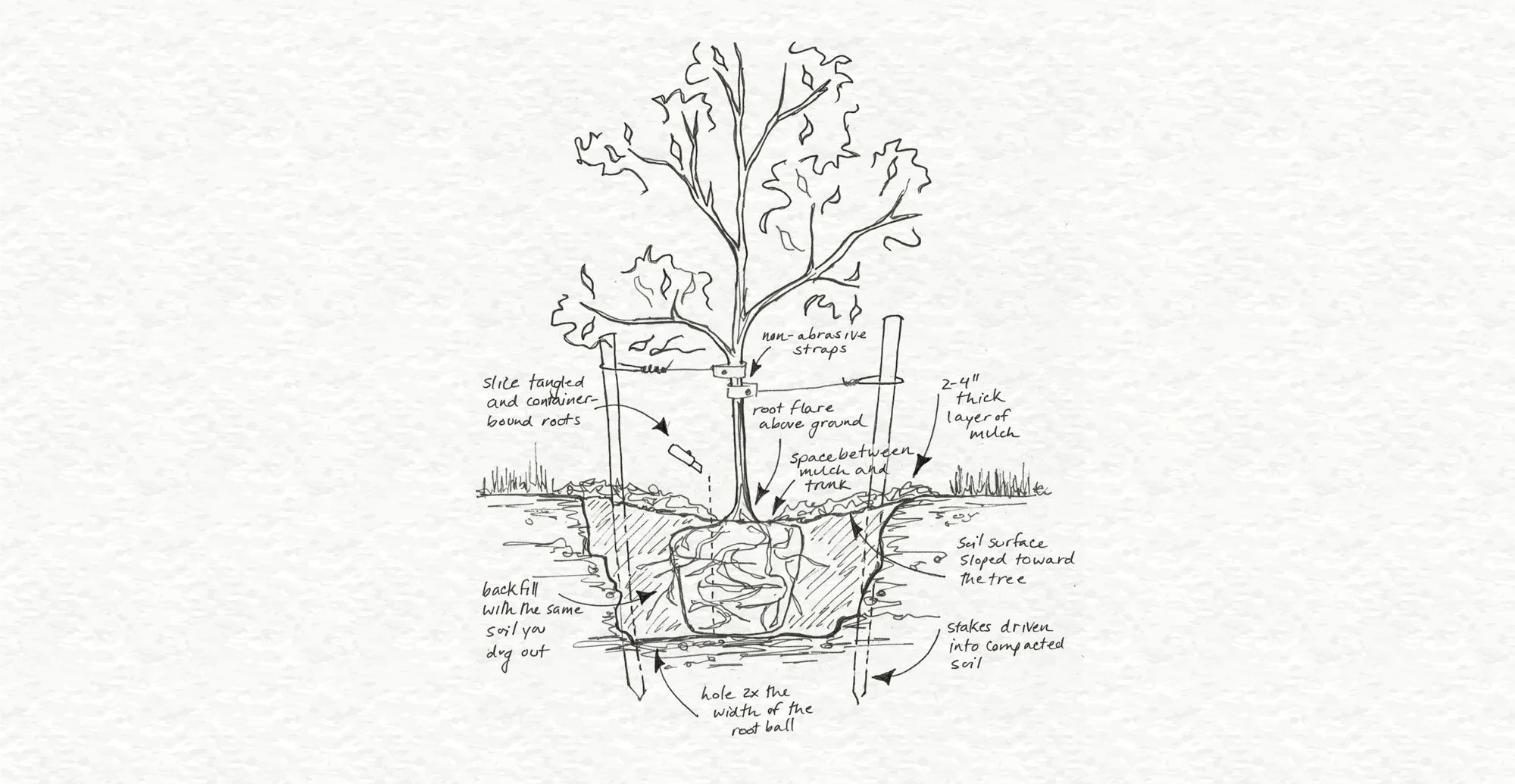
Dig a hole in the shape of a saucer, 2x wider than the size of the root ball, to allow the roots plenty of room to spread out. Dig just deep enough to where the “root flare” will be above the finished soil surface.
Detangle roots so they are oriented to grow outwards, away from the trunk. If the tree was potted, gently break up or slice crowded and tightly wound roots. Roots that grow up or in a circle can kill the tree. If using a balled and burlapped sapling, cut away the wire and fabric from the top of the root ball.
Support bare-root saplings from underneath with a mound of compacted soil to prevent settling.
Backfill the hole gently with the same soil you dug out, making sure there are no air pockets. Only amend the soil with compost or fertilizer if you’ve had issues with growing plants due to poor soil quality. This helps the tree adapt to its new home more quickly. Do not bury the tree past the “root flare”- burying a sapling too deep can kill it.
Shape the soil around the base of the tree into a slight depression so that water drains towards the tree.
Add mulch in a 3-4” layer in a wide circle around the tree, but not directly against the trunk. Mulch helps retain moisture and suppresses unwanted weeds and grasses.
Deeply water the tree immediately after planting. Being transplanted is stressful business.
Use stakes and non-abrasive straps to stabilize the tree only if it is tippy or might get pushed over. Be sure to drive stakes beyond the disturbed soil. Remove hardware after one year: trees need to learn to hold themselves upright.
Trunk wrap helps shield the young bark from getting sunburned - especially in winter when the sun reflects off of the snow. Install trunk wrap in the fall and remove in the spring. Trunk guards protect against weed wackers. Damaged bark can slow growth or kill a tree.
Protect with a 4-5’ welded wire fence when planting trees in areas with lots of deer. Deer will munch tender branches and rub the young bark off the trunk. Note: fencing is not included in the voucher.
Care
Water right away after planting, then once every 2-3 weeks from late spring until the ground freezes in the fall, for 2-3 years. If the weather is hot and dry or the soil is well drained, plants may need more frequent watering, especially for the first couple of weeks. Water deeply to saturate the root zone, making sure to water beyond the tree's dripline and not just at the trunk. The rule of thumb is 10 gallons/inch of trunk/week. Consider using a watering bag that zips around the trunk of the tree and slowly leaks water into the soil.
Prune only dead branches and upright branches competing with the leader. Leave pruned material on the ground, unless it is diseased. Let new plants become established for two years before pruning more substantially, if at all.
Protect new trees and shrubs temporarily if necessary. You can fence off your tree depending on how many deer are around. Remove any stakes and straps one year after planting to let the tree build strength. Remove deer fencing after leaders are above browsing height. Remove trunk protection once the bark has grown thicker and can handle some sun, deer rubbing, or a nick from the weed wacker.
Mulch helps retain moisture and suppresses unwanted weeds and grasses. To give new plants a fighting chance against fast-growing and greedy species, add a thick layer of mulch around trees and shrubs twice a year for 2-7 years. Once established, riparian ecosystems shade out undesirable understory plants and essentially mulch themselves with fallen leaves and branches.
Keep grasses and weeds at bay. Treating weeds and mowing around your new plants for a couple of years helps knock down the competition for sun, water, and nutrients until they are able to reach higher and deeper and fend for themselves.